How Much Are You Really Spending on Subscriptions?
How much do you spend on subscriptions? Convert every weekly, quarterly and yearly plan to monthly, add them up and see your true yearly total.

Key takeaways
- Convert every subscription to a monthly cost first: yearly ÷ 12, quarterly ÷ 3, weekly × 52 ÷ 12.
- Multiply the monthly total by 12 to see the yearly number, which is usually the one that changes minds.
- Weekly and yearly charges are the easiest to underestimate, so check them twice.
- Cost per use and the "would I sign up today?" test tell you which subscriptions are worth keeping.
To find out how much you spend on subscriptions, list every one you pay for, convert each price to a monthly cost, and add them up. Yearly plans divide by 12, quarterly plans divide by 3, and weekly charges multiply by 52 and then divide by 12. Multiply your monthly total by 12 to see the yearly figure.
Most people guess low. That's because the number in your head is usually your two or three biggest monthly subscriptions, not the yearly renewals, the weekly charges or the small add-ons.
Below is the full method: the formulas, a worked example with eight subscriptions, and two simple tests for deciding what's actually worth the money.
Why your guess is probably too low#
Subscriptions are built to feel small. A $9.99 charge looks like nothing on its own, and you rarely see all of them side by side.
A few things make the real total bigger than it feels:
- Yearly renewals don't show up in a normal month, so they're left out of mental math.
- Weekly charges feel like "about four a month", but most months have more than four weeks.
- Add-ons and upgrades (extra storage, an ad-free tier, a channel add-on) are easy to forget.
- Price increases happen quietly, so the price you remember may not be the price you pay.
- Different payment methods mean no single statement shows everything.
The fix is to do the math once, properly, with every subscription on one page.
Step 1: Make a complete list first#
You can't total what you haven't found. Before calculating anything, gather every subscription from your Apple ID or Google Play list, PayPal, Amazon, your email and 12 months of card statements. Our guide on how to find every subscription you're paying for covers each place to look.
For each one, write down three things:
- The price you're actually charged (check the most recent receipt or statement, not the price you signed up at)
- The billing cycle: weekly, monthly, quarterly, every six months or yearly
- The name of the service
Include tax if it's added to the charge. The number on your statement is the one that matters.
Step 2: Convert every price to a monthly cost#
Different billing cycles can't be added together directly. Converting everything to the same unit (a month) makes them comparable.
The conversion formulas#
| Billing cycle | Formula for monthly cost | Example |
|---|---|---|
| Weekly | price × 52 ÷ 12 | $3.00 × 52 ÷ 12 = $13.00 |
| Every 2 weeks | price × 26 ÷ 12 | $10.00 × 26 ÷ 12 = $21.67 |
| Monthly | price | $15.49 = $15.49 |
| Quarterly (every 3 months) | price ÷ 3 | $30.00 ÷ 3 = $10.00 |
| Every 6 months | price ÷ 6 | $60.00 ÷ 6 = $10.00 |
| Yearly | price ÷ 12 | $139.00 ÷ 12 = $11.58 |
Why weekly isn't "times four"#
A year has 52 weeks, and 52 ÷ 12 = 4.33 weeks per month on average. If you multiply a weekly charge by 4, you undercount by about a third of a week every month.
For a $3 weekly charge, "times four" says $12 a month. The real average is $13.00. Over a year, that's $156 versus the $144 you'd have guessed.
Watch out for "every 4 weeks" billing#
Some services bill every four weeks instead of once a calendar month. That sounds the same, but it isn't. A year has 52 weeks, so a four-weekly plan charges you 13 times, not 12.
For a $9.99 charge every four weeks:
- Yearly cost: $9.99 × 13 = $129.87
- Monthly cost: $129.87 ÷ 12 = $10.82
If you'd assumed it was a normal monthly plan, you'd have estimated $9.99 × 12 = $119.88 a year, almost $10 short. Check the receipt dates: if they drift a few days earlier each month, the plan is four-weekly.
Converting to a yearly cost#
Once you have the monthly cost, the yearly cost is simple: monthly × 12. Or work it out straight from the original price:
- Weekly: price × 52
- Monthly: price × 12
- Quarterly: price × 4
- Every 6 months: price × 2
- Yearly: price
Step 3: Add it all up (a worked example)#
Here's a realistic list of eight subscriptions with a mix of billing cycles. The prices are examples, not current prices for any particular service.
| Subscription | Price | Cycle | Monthly cost | Yearly cost |
|---|---|---|---|---|
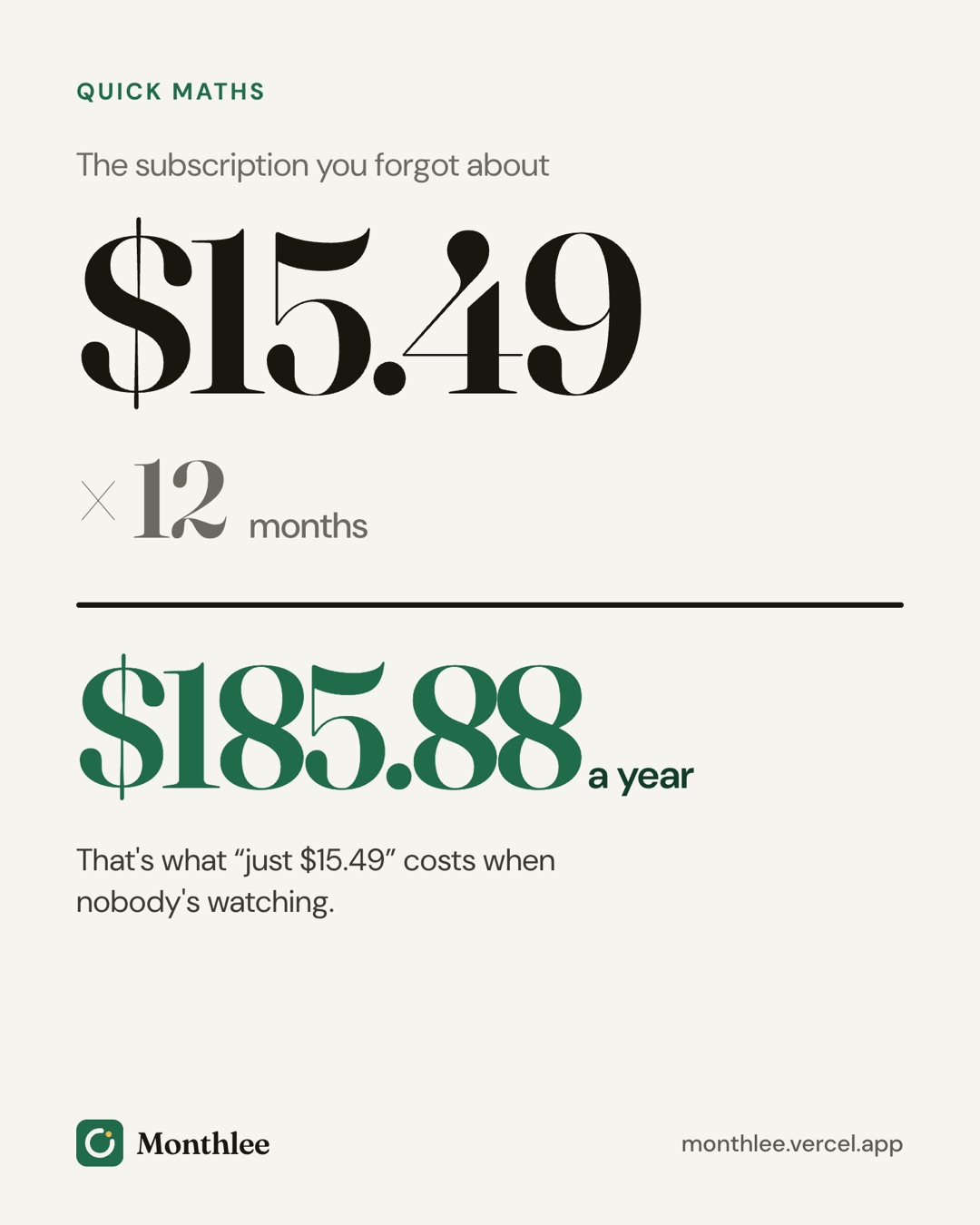
| Video streaming | $15.49 | Monthly | $15.49 | $185.88 |
| Music streaming | $11.99 | Monthly | $11.99 | $143.88 |
| Cloud storage (e.g. iCloud+) | $2.99 | Monthly | $2.99 | $35.88 |
| Gym membership | $40.00 | Monthly | $40.00 | $480.00 |
| AI assistant (e.g. ChatGPT Plus) | $20.00 | Monthly | $20.00 | $240.00 |
| Digital newspaper | $3.00 | Weekly | $13.00 | $156.00 |
| Shopping membership | $139.00 | Yearly | $11.58 | $139.00 |
| Skincare refills | $30.00 | Quarterly | $10.00 | $120.00 |
| Total | $125.05 | $1,500.64 |
How the totals were calculated#
The monthly column adds up like this:
$15.49 + $11.99 + $2.99 + $40.00 + $20.00 + $13.00 + $11.58 + $10.00 = $125.05 a month
The yearly column:
$185.88 + $143.88 + $35.88 + $480.00 + $240.00 + $156.00 + $139.00 + $120.00 = $1,500.64 a year
If you multiply the monthly total by 12 you get $1,500.60. The 4-cent difference comes from rounding the yearly membership to $11.58 a month. Either number is fine for planning.
What this example shows#
Look at where the money actually goes:
- The gym alone is almost a third of the yearly total: $480.00 out of $1,500.64.
- The weekly newspaper looks like the cheapest item at $3, but it costs more per year ($156) than the music service ($143.88).
- The two non-monthly items (the yearly membership and quarterly refills) add $259 a year that would never show up if you only checked one month's statement.
That's the value of doing the math. The biggest surprises usually come from the charges you weren't counting.
Step 4: Look at cost per use#
A total tells you how much you spend. Cost per use tells you whether each subscription is worth it.
The formula is simple:
Cost per use = monthly cost ÷ times used in a month
Using the example above:
- Gym: $40.00 ÷ 4 visits = $10.00 per visit. If a drop-in pass costs less than that, you're overpaying for a membership you don't use enough.
- Video streaming: $15.49 ÷ 3 evenings = $5.16 per evening. Not bad, but if you only watch one show, you could rotate services instead.
- AI assistant: $20.00 ÷ 25 days of use = $0.80 per day. Heavily used and cheap per use.
Cost per use isn't the only measure. A meditation app you open twice a month might still be worth it to you. But it quickly shows which subscriptions earn their place and which are coasting.
If you're paying for several video services, rotating streaming services one at a time is one of the easiest ways to cut the total without giving anything up for good.
Step 5: Apply the "would I sign up today?" test#
For each subscription, ask one question: if I weren't already paying for this, would I sign up for it today, at this price?
This flips the default. Instead of needing a reason to cancel, each subscription needs a reason to stay.
Three possible answers:
- Yes, without hesitation. Keep it. It's earning its place.
- Yes, but not at this price. Look for a cheaper tier, an ad-supported plan, a family plan you can share, or a yearly plan if you're sure you'll keep it. Our guide to monthly vs yearly subscriptions shows when paying upfront actually saves money.
- No. Cancel it, or at least turn off auto-renew so it ends at the close of the current period.
Be honest about the "I might use it" subscriptions. If you haven't opened it in two months, the answer is usually no.
Hidden costs to include in your total#
To get a true number, check for costs that don't appear in the headline price:
- Sales tax or VAT added at checkout
- Currency conversion or foreign transaction fees for services billed in another currency
- Price increases since you signed up; compare your latest receipt to the original
- Add-ons: extra storage, an extra screen, a premium channel, a "family" upgrade
- Hardware-linked plans: device insurance, cloud backup for a camera, a smart home plan
Price changes are the sneakiest of these. Services usually email you before a price goes up, but the email is easy to miss, so compare your latest receipt with the price on your list every few months.
How to keep the total up to date#
Your total is only useful if it stays accurate. Subscriptions change all the time: free trials convert, prices rise, you add a new app on a whim.
A few simple habits help:
- Update the list the day you sign up for anything new, including free trials.
- Check your total once a month, when you'd normally look at your budget.
- Set a reminder before each renewal so you can decide before you're charged, not after.
- Run a full review once or twice a year with a subscription audit.
You can do all of this in a spreadsheet using the formulas above. If you'd rather not maintain one, Monthlee adds up your subscriptions for you: it shows your monthly and yearly totals, spending by category and your biggest costs, and you add subscriptions yourself rather than linking a bank account.
Setting a target#
Once you know your real number, decide what you want it to be. Some people pick a fixed monthly limit for all subscriptions. Others pick a category limit, such as "no more than two video services at a time". Either way, a target turns a number into a decision. For a fuller approach, see how to budget for subscriptions.
The bottom line#
To work out how much you really spend on subscriptions, list every one, convert each price to a monthly cost (yearly ÷ 12, quarterly ÷ 3, weekly × 52 ÷ 12), add them up, then multiply by 12 for the yearly figure.
Then go line by line. Check cost per use, ask whether you'd sign up today at this price, and cancel or downgrade anything that doesn't pass. Keep the list updated so the next time someone asks how much you spend, you already know.
Frequently asked questions
How do I calculate how much I spend on subscriptions?
List every subscription with its price and billing cycle, convert each one to a monthly cost (yearly ÷ 12, quarterly ÷ 3, weekly × 52 ÷ 12), then add them up. Multiply that monthly total by 12 to get your yearly spend.
How do I convert a weekly subscription to monthly?
Multiply the weekly price by 52 and divide by 12. A $3 weekly charge is $3 × 52 ÷ 12 = $13.00 a month, not $12, because most months have slightly more than four weeks.
How much should I spend on subscriptions per month?
There's no single right number. A useful rule is that your subscriptions should fit comfortably inside your budget for wants, and each one should pass a simple test: if you weren't already paying, would you sign up today at this price?
What is cost per use for a subscription?
Cost per use is the monthly price divided by how many times you used the service that month. A $40 gym membership used four times costs $10 per visit, which makes it easy to compare against paying per visit or choosing a cheaper option.
Know every charge before it lands.
Monthlee keeps your subscriptions, bills and free trials in one calm list and reminds you before each charge. No bank login. Free for up to 5 subscriptions.
Download on theApp Store- Reminders 1, 2, 3 or 7 days before
- Free-trial warnings
- Monthly and yearly totals
- Cancel guides with direct links
Keep reading
 Save money
Free Alternatives to Paid Subscriptions Worth Trying
Free alternatives to subscriptions: free tiers, library apps, built-in phone apps, open-source software and shared plans, with honest trade-offs for each.
 Save money
Subscriptions on a Student Budget: Keep, Cut and Discounts
How to manage student subscriptions on a tight budget: decide what to keep or cut, check for student pricing, use free campus resources and pause over summer.
 Save money
The Subscription Detox: A 30-Day Reset
A subscription detox is a 30-day reset: pause or cancel everything non-essential, notice what you miss, then add back only what earns its place.