How to Cancel a Gym Membership Without Surprise Fees
How to cancel a gym membership: check your contract and notice period, cancel in writing, keep proof, and why blocking your card doesn't end the contract.
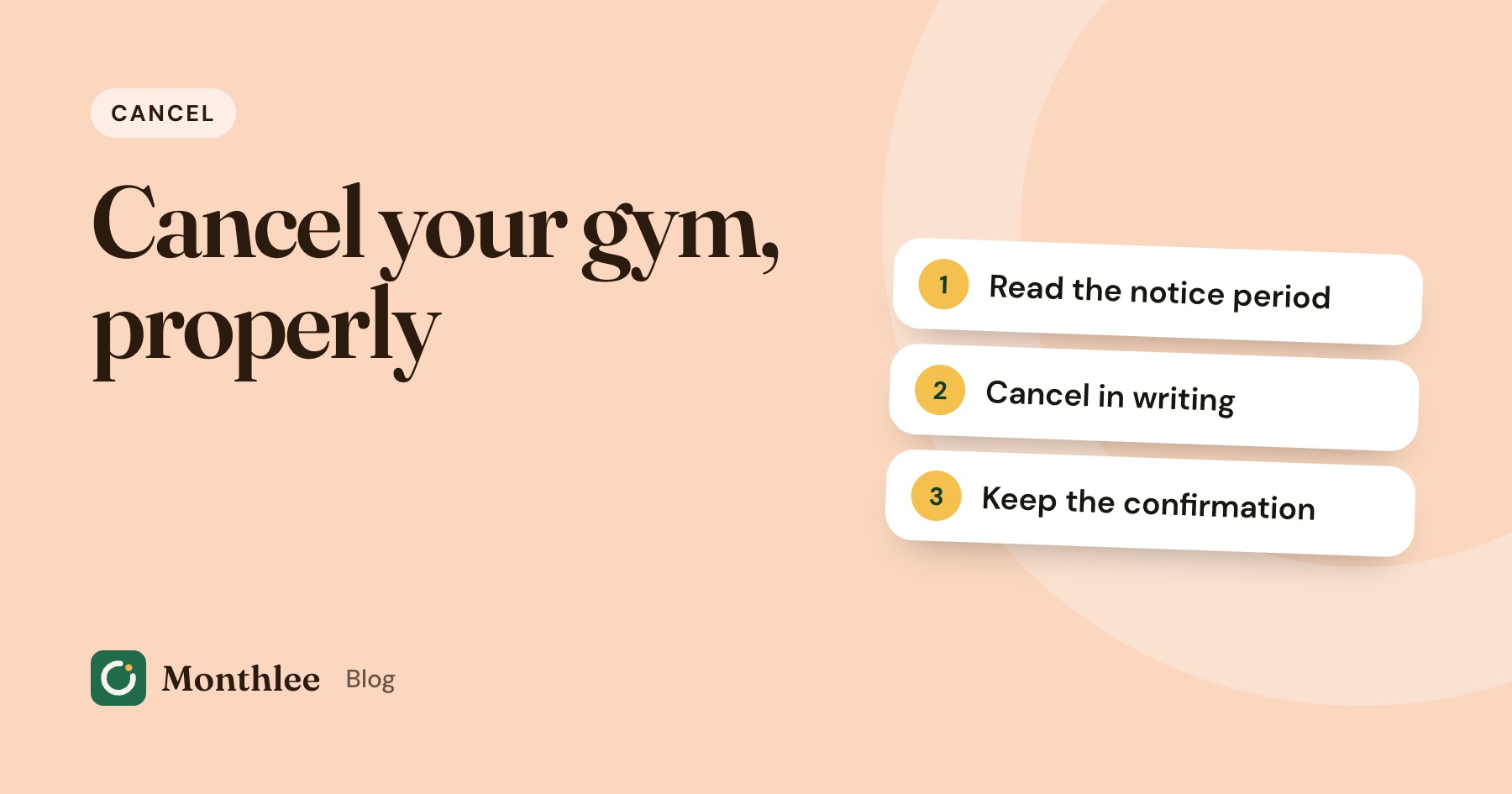
Key takeaways
- Find your contract first: the minimum term, the notice period and the accepted cancellation methods decide when you can leave and how.
- Count the notice period back from your next billing date so you know which payment will be your last.
- Cancel using the method the contract names, ideally in writing, and keep the confirmation, the date and a copy of what you sent.
- Blocking your card or cancelling the payment doesn't cancel the membership; you may still owe the money and it can be passed to collections.
- Rules on gym contracts vary by country and state, so if a gym won't let you leave, ask a local consumer advice service or your bank.
To cancel a gym membership, find your contract, check the minimum term and the notice period, then cancel using the method the contract names: online, by email, by letter or in person. Ask for written confirmation, note which payment will be your last, and check your statement afterwards to make sure the charges actually stop.
The step that causes the most trouble is skipping the contract and going straight to your bank. Blocking the card or cancelling the payment stops the money, but it doesn't end the agreement. The gym may still say you owe it.
Gym rules vary a lot between countries, states and chains. What follows is a general guide that works almost anywhere, with notes on where local rules may give you more options.
Why gym memberships are harder to cancel than apps#
Most app subscriptions are month-to-month: you cancel in a few taps and keep access until the end of the period. Gyms are different for a few reasons:
- Contracts with a minimum term. Many memberships lock you in for 6, 12 or more months, especially if you got a lower monthly rate for committing.
- Notice periods. Even after the minimum term, you may need to give a set amount of notice before the payments stop.
- Specific cancellation methods. Some gyms accept cancellation only in person, by letter, or through a particular form.
- Extra fees. Annual maintenance fees, early termination fees and freeze fees can appear in the small print.
None of this means you're stuck. It means a little preparation saves you from paying for months you didn't plan to. If you're dealing with other memberships that have the same kind of rules, the guide on hard-to-cancel subscriptions and memberships covers clubs, newspapers and software contracts too.
Step 1: Find your contract and read four things#
Look for the agreement you signed, the welcome email, or the terms page on the gym's website. Your online member account may also show your plan. Then find these four details:
- Minimum term. Are you still inside a fixed contract period? If so, leaving early may mean paying the rest or an early termination fee.
- Notice period. How much notice do you have to give? It's often written as a number of days or "one full billing cycle".
- Cancellation method. Online, email, letter, in person or a form. The contract usually says which ones count.
- Other fees. Annual fees, cancellation fees, and anything owed for the notice period.
Write them down. If you can't find your contract, ask the gym for a copy in writing. You're entitled to know what you agreed to, and the request itself creates a record.
Types of gym contracts#
| Contract type | What it usually means | What to watch for |
|---|---|---|
| Month-to-month, no minimum | You can leave with the stated notice | The notice period can still add one more payment |
| Fixed term (e.g. 12 months) | You've committed to a set number of payments | Early exit may cost the remaining months or a fee |
| Fixed term that rolls over | After the term, it becomes month-to-month or renews | Some renew for another full term if you don't cancel in time |
| Paid in full upfront | You've already paid for a period | Refunds for unused time depend on the contract and local rules |
| Annual fee on top | A yearly charge separate from monthly dues | It may be billed on a set date even if you joined recently |
Step 2: Work out your last payment date#
The notice period is easiest to understand as a date. Take your next billing date and count back.
A worked example#
Say your membership costs $45 a month, billed on the 1st, with a 30-day notice period. Today is 10 March.
- If you give notice today, 30 days later is 9 April.
- The 1 April payment falls inside the notice period, so you'll still pay it.
- The 1 May payment falls after the notice ends, so it shouldn't be taken.
Your last payment is 1 April: one more $45 charge. If you waited until 5 April to give notice, the notice would run to 5 May, the 1 May payment would fall inside it, and you'd pay another $45. Giving notice early in the billing cycle doesn't always change the outcome, but giving it late almost always costs you.
Now say you're 8 months into a 12-month contract at $45 a month, with no early exit option. Leaving now could mean paying the remaining 4 months: 4 × $45 = $180. Staying until the term ends costs the same, so the question is only whether you'd use the gym in those months. If the contract offers an early termination fee of, for example, $75, that's cheaper than $180, and you'd save $180 − $75 = $105.
The numbers are examples. Use your contract's figures.
Step 3: Check whether you qualify for early cancellation#
Many gym contracts, and some local laws, allow you to leave early in certain situations. Common ones include:
- Moving away, often beyond a set distance from the nearest branch, with proof of address.
- Medical reasons, usually with a doctor's note saying you can't exercise.
- Job loss or financial hardship, at some gyms.
- The gym closing, relocating or changing its facilities significantly.
- A cooling-off period right after you sign, in some places.
Whether these apply depends on your contract and where you live, so don't assume. Read the clause, then ask the gym in writing what documents they need. If the gym closes or changes hands, check whether your contract moves to the new owner.
Consider a freeze instead#
If you only need a break, for an injury, travel or a busy few months, ask about freezing. Many gyms let you pause your membership for a monthly fee or for free for a set time. Freezes sometimes extend your contract term by the frozen months, so check that detail before agreeing.
Step 4: Cancel in the way your contract requires#
Use the method the contract names. If it lists several, choose the one that leaves the best paper trail.
- Online or in the app. If your member account has a cancel option, use it and screenshot the confirmation page and any reference number.
- By email. Send it to the address given for cancellations. Include your full name, membership number, the date, and a clear sentence: "I am cancelling my membership. Please confirm the date of my final payment."
- By letter. If the contract requires a letter, send it in a way you can prove, such as a tracked or signed-for service. Keep a copy.
- In person. Ask for a written or emailed confirmation before you leave the desk. Note the name of the staff member and the time.
There's a ready-to-use template in how to write a subscription cancellation email. Keep it short and factual; you don't need to give a reason unless you're using an early-exit clause.
Handling the retention pitch#
Gyms often offer a discount, a free month or a freeze when you try to cancel. If you want to stay at the new price, that's fine. If not, say "No thanks, please process my cancellation" and repeat it if needed. Don't let a retention conversation replace the cancellation itself.
Keep proof of everything#
If anything goes wrong later, your records are what fix it. Save:
- A copy of your contract or terms
- Your cancellation message, letter or form, with the date sent
- Postal tracking or delivery confirmation
- The gym's confirmation email or reference number
- Notes of any phone calls or desk visits: date, time and name
- Bank statements showing the final payment
Put them in one folder or email label. It takes two minutes and can save you hours.
Why blocking your card isn't the same as cancelling#
When a gym makes cancelling difficult, it's tempting to call the bank, block the card or cancel the payment, and walk away. Here's why that can backfire:
- The contract is still in force. Stopping the payment doesn't end what you agreed to. The gym can say you still owe the remaining payments.
- Fees can build up. Missed payments may bring late or admin fees under the contract.
- Collections. Some gyms pass unpaid memberships to a debt collection agency, which can be stressful and, in some countries, affect your credit record.
- A new card may not stop it. Card networks run updater services that can pass your new card number or expiry date to merchants that bill you regularly. Getting a replacement card doesn't reliably stop recurring charges. More on this in what happens to your subscriptions when your card changes.
- Direct debits are separate. If you pay from your bank account rather than a card, cancelling the debit still doesn't cancel the membership.
The right order is: cancel the membership with the gym first, get confirmation, and only then use your bank as a backstop if charges continue.
What to do if the gym keeps charging you#
If a payment comes out after your cancellation should have taken effect:
- Contact the gym in writing. Attach your cancellation proof, list the charge dates and amounts, and ask for the charges to stop and be refunded.
- Give them a reasonable deadline, such as a week, to reply.
- If they don't fix it, contact your bank or card issuer. Explain that you cancelled and show your proof. They can tell you what options you have for disputing the charges or stopping future ones.
- Get local advice if needed. Consumer protection agencies, ombudsmen and advice services in many countries handle gym contract complaints. Rules differ by country and state, so a local service can tell you what applies to you.
If the gym's charge shows up on your statement under an unfamiliar name, what to do about an unknown subscription charge explains how to match it to the right business before you contact your bank.
Check your statements after you cancel#
Don't assume the cancellation worked. Put two reminders in your calendar:
- The day after your final payment, to check it was the right amount.
- The day after the next billing date, to check that no further payment was taken.
Also watch for an annual fee that might be billed separately, sometimes months after you joined.
If you track your other subscriptions in one place, add the gym with its notice period in the notes. Monthlee lets you add a gym membership like any other recurring charge, with no bank login, and reminds you before each charge, which is handy when you're timing a notice period. When you cancel, deleting it with "I cancelled it" counts what you're saving.
Before you join your next gym#
The easiest cancellation is one you planned for at sign-up. Before signing a new membership:
- Ask for the cancellation terms in writing and read them before you pay.
- Prefer month-to-month if you're not sure you'll stick with it, even if it costs a little more per month.
- Check the total cost of a fixed term: $35 × 12 = $420 for a year, plus any annual fee.
- Ask how to cancel: online, email or in person only.
- Ask about freezes, moving and medical clauses.
- Set a reminder a few weeks before any minimum term ends.
If you're cutting back on spending generally, a subscription budget helps you decide whether a gym earns its place next to everything else you pay for.
The bottom line#
To cancel a gym membership, read your contract for the minimum term, notice period and cancellation method, then cancel in that way, in writing where you can, and keep proof. Work out which payment is your last so there are no surprises.
Don't rely on blocking your card or cancelling the payment: that stops the money but not the contract. Cancel properly first, check your statements afterwards, and if charges continue, contact the gym in writing and then your bank or card issuer. Because gym rules vary by country and state, a local consumer advice service is the place to go if you're stuck.
Frequently asked questions
Can I cancel my gym membership by just stopping payment?
Not safely. Stopping the payment ends the money, not the contract, so the gym may still treat you as a member, add late fees or pass the debt to a collection agency. Cancel the membership properly first, then make sure the payments stop.
How much notice do I need to give to cancel a gym membership?
It depends on your contract. Many gyms ask for notice of around 30 days or one billing cycle, and some require more. Check the cancellation section of your agreement or the gym's terms on its website.
Can I cancel a gym membership if I move away?
Often, yes. Many gym contracts allow early cancellation if you move a certain distance away, and some laws in some places require it, but you may need to show proof of your new address. Check your contract and ask the gym before assuming.
Can I cancel a gym contract early for medical reasons?
Many gyms let you freeze or cancel early with a doctor's note, but the terms vary by gym and by location. Read the contract's medical clause or ask the front desk what documents they need.
What should I do if my gym keeps charging me after I cancelled?
Contact the gym in writing with your cancellation proof and ask for the charges to stop and be refunded. If they don't respond or refuse, contact your bank or card issuer, and keep copies of everything.
Know every charge before it lands.
Monthlee keeps your subscriptions, bills and free trials in one calm list and reminds you before each charge. No bank login. Free for up to 5 subscriptions.
Download on theApp Store- Reminders 1, 2, 3 or 7 days before
- Free-trial warnings
- Monthly and yearly totals
- Cancel guides with direct links
Keep reading
 Cancel
How to Cancel Adobe Subscription (and Avoid the Fee)
How to cancel your Adobe subscription on the web or through Apple and Google Play, plus how the early cancellation fee on annual plans paid monthly works.
 Cancel
How to Cancel Apple TV+ (Now Called Apple TV)
How to cancel Apple TV+, now called Apple TV, on iPhone, Mac, Apple TV 4K, Android, Windows or the web, plus Apple One, carrier and Peacock bundle cases.
 Cancel
How to Cancel Audible (and Keep Your Audiobooks)
How to cancel Audible on the website, through the App Store or Google Play, what happens to your credits and books, and when pausing makes more sense.