How to Share and Split Subscription Costs With Family
How to split subscription cost fairly with family: check family plan rules, choose an equal or usage-based split, collect payments and keep one shared list.

Key takeaways
- Read each service's sharing rules first; many family plans are limited to people in one household.
- An equal split is simplest; a usage-based split is fairer when one person uses far more.
- One person should pay the service and collect from everyone else on a fixed day each month.
- Keep one shared list with each plan's price, renewal date, owner and who pays what.
- Agree in advance what happens when someone leaves so nobody gets stuck with the full bill.
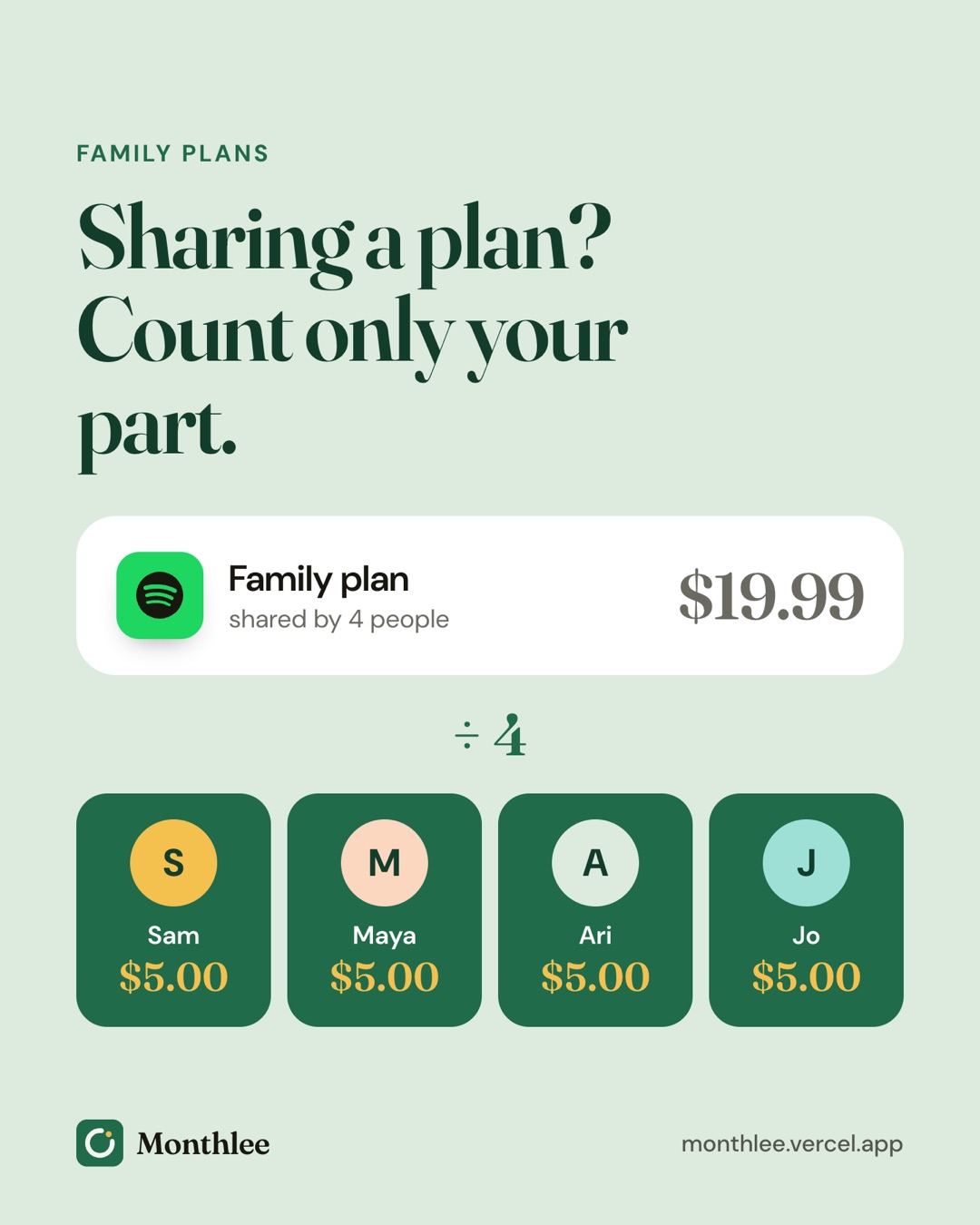
To split a subscription cost with family, one person pays for a family or shared plan and everyone else pays them their share. The simplest method is an equal split: a $17.99 family plan shared by five people is about $3.60 each. If one person uses the service far more than everyone else, a split based on usage can feel fairer.
Before you set anything up, check the service's sharing rules, because many family plans are limited to people in one household. Then agree on three things: how you split the cost, how and when people pay, and what happens if someone leaves.
Below is how family plans generally work, fair ways to divide the bill, a worked example, and how to keep everything in one shared list so nobody loses track.
How family and shared plans generally work#
Most streaming, music, storage and software services offer some version of a plan for several people. The details vary a lot from service to service, but the general pattern looks like this:
- One person is the owner (or organizer). They hold the account, pay the bill, and invite or remove members.
- Members get their own profile or login. Their history, playlists, files or settings usually stay separate.
- There's a cap on members. Five or six people is common, though it varies.
- There are rules about who counts. Many plans are limited to one household, meaning people who live at the same address.
Check the rules before you invite anyone#
This is the step people skip. Before you add a sibling across town or a friend, read the service's terms or its help page on family plans. Look for:
- Who can join. Same household only, or anyone?
- How many members. Including or excluding the owner?
- Location checks. Some services check where members are using the account.
- Age rules. Some features or plans have age requirements for the owner or members.
- Switching limits. Some plans limit how often you can join or change family groups.
Menus and terms change, so check the current version on the service's own site rather than relying on what a friend remembers.
App store family sharing#
If you're on iPhone, Apple's Family Sharing lets a family group of up to six people share eligible App Store subscriptions. Google Play has a similar family group. Not every app supports it, and the developer decides whether a subscription can be shared. Look for a family-sharing note on the app's store page or in your subscription settings.
Fair ways to split subscription costs#
There's no single right method. The best one is the one everyone agrees to before money changes hands.
Equal split#
Divide the price by the number of people. It's simple, easy to explain, and works when everyone uses the service roughly the same amount.
Example: a $16.99/month music family plan for six people.
$16.99 ÷ 6 = $2.83 each (rounded). Six people paying $2.83 is $16.98, so the owner covers the extra cent.
Usage-based split#
Divide by how much each person uses. This suits services where use is uneven and measurable, like cloud storage.
Example: a $9.99/month 2 TB storage plan shared by three people.
| Person | Storage used | Share of usage | Monthly share |
|---|---|---|---|
| Alex | 1,000 GB | 50% | $9.99 × 0.50 = $5.00 |
| Sam | 600 GB | 30% | $9.99 × 0.30 = $3.00 |
| Jo | 400 GB | 20% | $9.99 × 0.20 = $2.00 |
| Total | 2,000 GB | 100% | $10.00 |
The exact shares are $4.995, $2.997 and $1.998, which round to $10.00, a cent above the price. Small rounding gaps like this are normal; just agree who absorbs them.
Owner discount or "host pays more"#
Sometimes the person who manages the account pays a bit less as thanks for handling it, or pays a bit more because the service is mostly theirs and the others are tagging along. Either is fine if it's agreed openly.
Trade instead of split#
Families with several services sometimes skip the math entirely. One person pays for streaming, another pays for music, a third pays for cloud storage, and everyone shares all three. This works best when the services cost roughly the same.
Here's how the options compare:
| Method | Best for | Pros | Cons |
|---|---|---|---|
| Equal split | Streaming, music | Simple, easy to explain | Feels unfair if usage is very uneven |
| Usage-based | Cloud storage, data | Fair when use varies | Needs checking and recalculating |
| Host discount | Any plan | Rewards the person doing the admin | Needs clear agreement |
| Trade services | Several plans in one family | No money changes hands | Breaks down if prices drift apart |
A worked example: splitting several family plans#
Say a household of four adults shares three family plans. The prices below are examples, not current prices for any service.
| Plan | Monthly price | People | Per person (equal) | Per person per year |
|---|---|---|---|---|
| Streaming family plan | $17.99 | 4 | $4.50 | $54.00 |
| Music family plan | $16.99 | 4 | $4.25 | $51.00 |
| Cloud storage 2 TB | $9.99 | 4 | $2.50 | $30.00 |
| Total | $44.97 | $11.25 | $135.00 |
The math, step by step:
- Streaming: $17.99 ÷ 4 = $4.4975, rounded to $4.50
- Music: $16.99 ÷ 4 = $4.2475, rounded to $4.25
- Storage: $9.99 ÷ 4 = $2.4975, rounded to $2.50
- Each person pays $4.50 + $4.25 + $2.50 = $11.25 a month, or $11.25 × 12 = $135.00 a year
Compare that to each person paying for individual plans. If individual versions were, for example, $15.49 for streaming, $11.99 for music and $2.99 for a smaller storage plan, that's $30.47 a month or $365.64 a year per person. Sharing saves each person $365.64 − $135.00 = $230.64 a year in this example.
Rounding up to the nearest quarter, as here, gives the owner a few extra cents a month ($45.00 collected vs $44.97 paid). That small cushion helps cover a price increase without renegotiating right away.
How to collect money without awkward reminders#
The split is the easy part. Collecting it every month, without nagging your own family, is where shared plans tend to fall apart.
Pick one payer and one payday#
- One person pays the service. Usually the plan owner, using their own card.
- Everyone pays the owner on the same day each month. Pick a date a few days before the plan renews.
- Use whatever your family already uses. A payment app or a recurring bank transfer both work. A recurring transfer is best because nobody has to remember.
Pay in larger chunks#
Monthly payments of $2.83 are fiddly. Consider:
- Quarterly: $2.83 × 3 = $8.49 every three months.
- Yearly: $2.83 × 12 = $33.96 once a year.
Fewer payments mean fewer reminders. If the service offers a yearly family plan that's cheaper than 12 monthly payments, collecting yearly can also let the owner switch to it. See monthly vs yearly subscriptions for how to compare.
Handle price increases up front#
Services raise prices from time to time. Agree now that when the price goes up, everyone's share goes up by the same proportion from the next payment. The owner should share the price-change email so nobody feels surprised. How to spot and handle subscription price increases covers what to look for.
Keep one shared list of everything you split#
When several people share several plans, the most common problem isn't money. It's confusion: who owns what, when it renews, and who has paid. A single shared list fixes that.
What the list should include#
For each shared subscription, record:
- Service and plan name (for example, "Music – family plan")
- Owner (whose card and account it's on)
- Price and billing cycle
- Next renewal date
- Members
- Each person's share
- How payment is collected (app, transfer, yearly upfront)
- Login or management link, so the owner can find the cancel or member page quickly
Where to keep it#
A shared spreadsheet or a shared note works. Everyone can see it, and the owner updates it when prices change. The weak spot is that nobody gets reminded when something renews, so dates drift out of date.
A tracker with a shared list can do the same job with reminders built in. In Monthlee, the Pro plan lets you share one subscription list with up to six people, and joining that list is free for the others. The Plus plan adds splitting a subscription's cost between people, so each person's share is written next to the plan instead of in someone's head. For the bigger picture of keeping everything in one place, see how to track all your subscriptions.
Turn on renewal reminders for shared plans#
Shared plans are easy to forget because only the owner sees the charge. A reminder a few days before each renewal gives the owner time to collect money or adjust the plan. How to get reminded before every subscription renews explains how to set this up.
What happens when someone leaves a shared plan#
People move out, get their own accounts, or just stop using a service. Agree on these rules when you set up the plan, not when someone's already leaving.
A simple leaving process#
- Give notice. Ask for one billing cycle's notice so the owner can plan.
- Settle up. The leaving person pays through the end of the current period.
- Remove them. The owner removes the member from the family group. Their profile or data may be deleted, so they should save anything they want to keep first.
- Recalculate. Divide the price by the new number of people.
- Update the shared list. Change the member list and everyone's share.
When the numbers stop working#
If a $16.99 plan drops from six people to three, each share jumps from $2.83 to $5.66 ($16.99 ÷ 3 = $5.663). At that point it's worth asking whether the plan still makes sense:
- Would one or two people be better off on individual plans?
- Is there a smaller plan, such as a two-person option?
- Could someone new join who lives in the household and is allowed under the rules?
When the owner leaves#
This is the tricky case, because the plan is on their account. Options:
- The owner keeps the plan and the others leave and sign up elsewhere.
- Someone else creates a new family plan and invites the remaining members.
Either way, set a date, because a family plan with no clear owner tends to keep charging one person's card long after the arrangement has fallen apart. If you end up cancelling, the steps are in how to cancel subscriptions on iPhone.
Common mistakes when splitting subscriptions#
A few things trip up families again and again:
- Ignoring the household rule. Adding people outside the home where the service doesn't allow it can get members removed.
- No agreed payday. "Pay me whenever" turns into weeks of reminders.
- Paying twice. A family member keeps their old individual plan after joining the family one. Ask everyone to cancel their own plan once they're in.
- Not passing on price increases. The owner quietly covers the difference for months, then resents it.
- Forgetting about a shared plan nobody uses. If a family plan has two inactive members, it may be time to downgrade.
The bottom line#
Start by reading each service's sharing rules, since many family plans are limited to one household. Agree on a method, either an equal split or one based on usage, and round to easy amounts. Have one person pay the service and everyone else pay them on a fixed day, ideally by recurring transfer or in quarterly or yearly chunks.
Keep one shared list with the owner, price, renewal date and each person's share, and agree now what happens when someone leaves. With those few rules in place, a shared plan saves everyone money without turning into a monthly chore.
Frequently asked questions
How do you split a subscription cost fairly?
Divide the monthly price by the number of people for an equal split, or by each person's share of usage for a usage-based split. Agree on the method before anyone joins, and round to the nearest cent so payments are easy.
Can I share a family plan with people outside my household?
It depends on the service. Many family plans are meant for people who live at the same address, and some check this. Read the service's terms or help page before adding anyone outside your home.
What is the easiest way to collect money for a shared subscription?
Have one person pay the service and ask everyone else to send their share on the same day each month through a payment app or a recurring bank transfer. Paying for a few months or a year upfront cuts down on reminders.
What happens to a family plan when someone leaves?
The plan owner removes them, and the remaining members either split the full price between fewer people or move to a cheaper plan. Agreeing on this in advance avoids awkward conversations later.
Know every charge before it lands.
Monthlee keeps your subscriptions, bills and free trials in one calm list and reminds you before each charge. No bank login. Free for up to 5 subscriptions.
Download on theApp Store- Reminders 1, 2, 3 or 7 days before
- Free-trial warnings
- Monthly and yearly totals
- Cancel guides with direct links
Keep reading
 Guides
How to Track All Your Subscriptions in One Place
How to track subscriptions in one list: find every charge, pick a method, record the right details, set reminders and review it all in 10 minutes a month.
 Guides
How to Share Subscriptions With Apple Family Sharing
How family sharing subscriptions work on iPhone: set up a family group, share eligible subscriptions, who pays, Ask to Buy for kids, and how to stop sharing.
 Guides
Merging Subscriptions as a Couple Without the Awkwardness
A practical guide to couples subscriptions: list both sets, cancel duplicates, decide what's shared or personal, split costs fairly and plan for a breakup.